

The state of AI apps in 2026: Installs, engagement, and retention

Three years after ChatGPT arrived on mobile, AI apps have become a mainstream category with growth rates the mobile industry hasn't seen in years.
AI apps are mobile apps that use generative AI to do a job for you: answer a question, draft an email, summarize a document, or turn a short prompt into an image or other finished output. People use them because they save time, whether that means getting an answer without searching, a first draft without a blank page, or an edited photo without learning an editing tool.
ChatGPT arrived on the App Store in May 2023, and the big tech companies have been chasing it since. Google, Microsoft and X are all investing in their own assistants, and apps like Claude, Grok and Perplexity now earn real money on mobile. Meanwhile, apps people already used have added AI of their own. Duolingo has a tutor you can talk to, and dating apps use AI to improve profiles. Photo apps use it to enhance pictures. Thus a wave of newer, more specific apps has followed – built to do one job, like turning a photo of your fridge into a recipe.
So the “rise” is not only more people using ChatGPT. It is AI becoming a standard ingredient in a large share of apps, plus a wave of new apps built around it.
Generative AI app downloads doubled to 3.8 billion in 2025, according to Sensor Tower's State of Mobile 2026 report, and in-app purchase revenue in the category nearly tripled to more than $5 billion. In a mobile market as mature as this one, where total downloads grew 0.8% last year, that growth stands out. ChatGPT became the fastest app to pass $5 billion in lifetime mobile consumer spending, reaching the milestone in about three years.
To see how AI apps perform once installed, we pulled the data on installs, sessions, session lengths, and retention from January 2024 through September 2026, split by subvertical and region.
TL;DR: Acquisition is still growing, engagement is growing faster, but the focus should be on retention.
Methodology: Unless stated otherwise, growth figures compare January through September 2026 (2026 YTD) with the same months in 2025.
Engagement is growing faster than installs
2025 was the breakout year in Adjust's data. Comparing January through September 2025 with the same months in 2024, AI app installs grew 104% and sessions grew 267%. In 2026, the category is still growing although the numbers look calmer, with installs up 14% and sessions 16% YoY. Growth that size on top of a record year still means more people installed an AI app in the first nine months of 2026 than in the same months of 2025. September 2026 was the strongest install month in the entire window we measured, 39% above the 2026 monthly average, so the flow of new users is still rising.
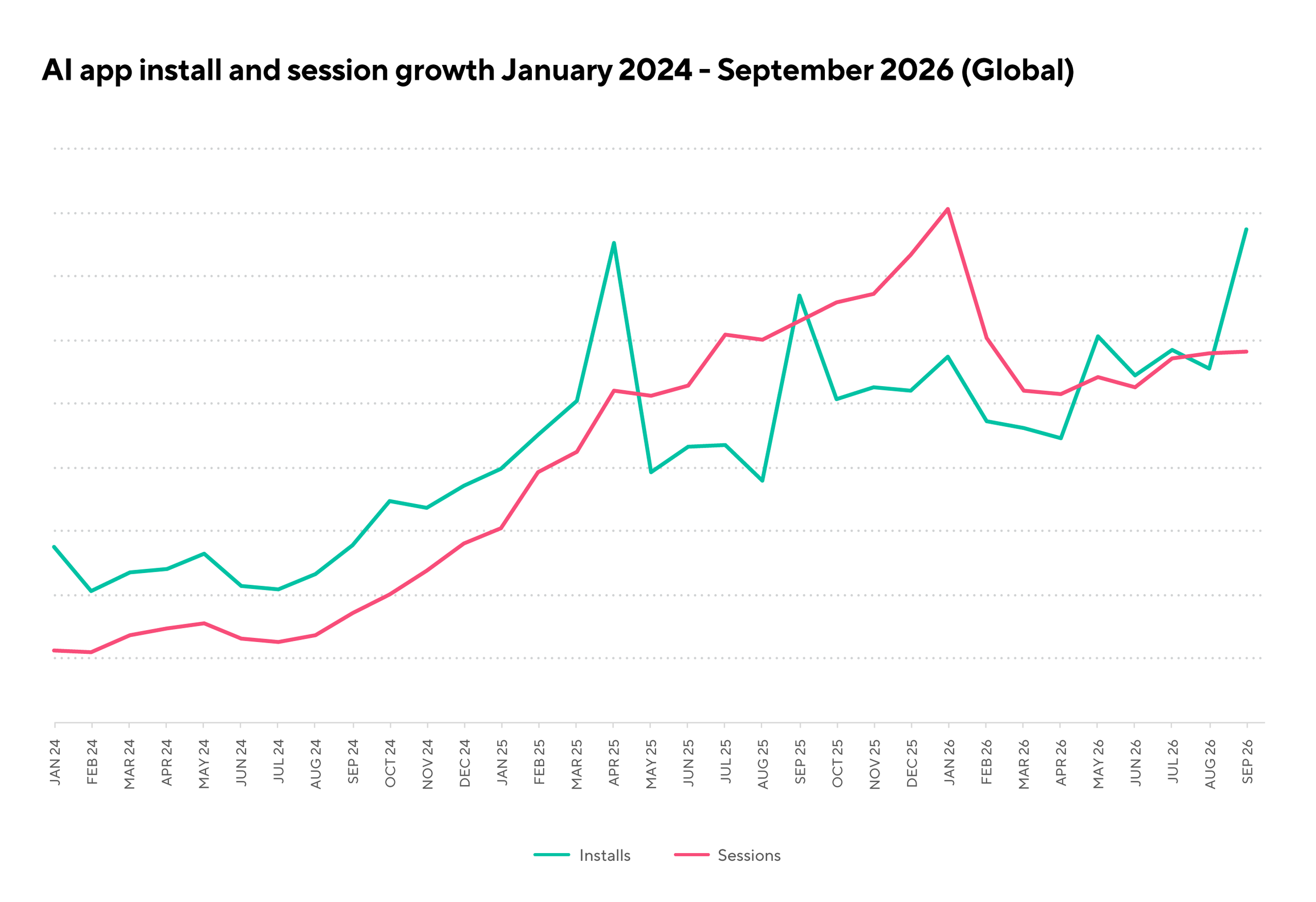
App sessions peaked in January 2026 at 38% above the January–September 2026 monthly average, fell through the spring to 7% below that average in May, and have been climbing again since. Even with that dip, every month of 2026 so far has recorded more sessions than any month of 2024 or the first half of 2025. Sensor Tower also reported more than one trillion generative AI app sessions in 2025 and noted that session volume is growing faster than downloads.
General AI apps and APAC lead on installs
At the subvertical level, general AI app installs increased fastest, up 36% and sessions up 30% YoY. AI content generators rose too, with installs up 22% and sessions up 21%.
Top-growing AI subverticals Jan-Sep 2026 YoY (Global)
Regionally, APAC posted the biggest install growth at 43%, three times the 14% global figure. Europe followed at 30% and MENA at 15%. In sessions, North America and APAC each grew around 16%, in line with the global rate.
AI app install growth highlights by region Jan–Sep 2026 YoY
AI app session growth highlights by region Jan–Sep 2026 YoY
Sessions got much longer
The average AI app session length was 17 minutes in 2024. In 2025 it reached 30.8 minutes, and in 2026 so far it sits at 30.4.
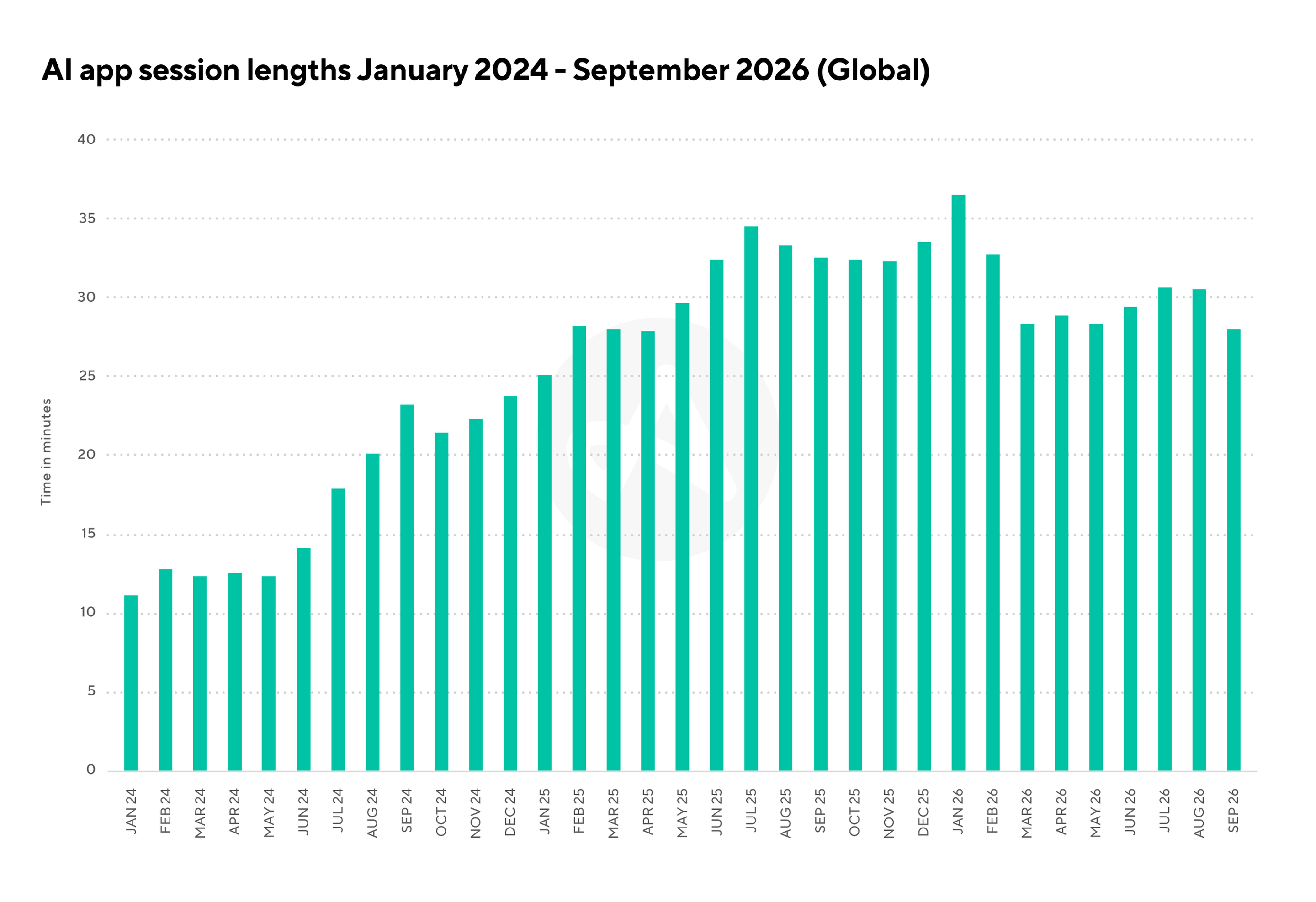
Month by month, session length peaked at 36.5 minutes in January 2026 and came down to 28 minutes by September, still well above anything in 2024.
The subverticals behave very differently, and the gap comes down to the job each app does. General AI apps hold users for 42.2 minutes a session in 2026, the longest in the vertical and up from 39.1 minutes in 2024. These apps bundle several uses in one place, such as open-ended chat, writing, search, and image tools, so one session often covers more than one task. AI assistant sessions average 17 minutes, down from 25.1 in 2025, consistent with quick question-and-answer use: ask, get the answer, close the app. Content generator sessions are the shortest at 11.2 minutes, which fits a tool you open with a specific output in mind. Users generate what they need, then leave.
AI app session lengths by subvertical 2024 - 2026 YTD (Global)
Time in minutes
By region, LATAM leads at 40.6 minutes per session, followed by North America at 37.1. Both have grown every year since 2024. Europe averages 27.5 minutes, with APAC and MENA around 21–22.
AI app session lengths by region 2024 - 2026 YTD
Time in minutes
Retention is where the work is
Day 1 retention for AI apps sits at 6.1% globally in 2026 so far, down from 6.8% in 2025 and 6.7% in 2024. By day 7 it falls to 2%, by day 14 to 1.2%, and by day 30 to 0.7%.
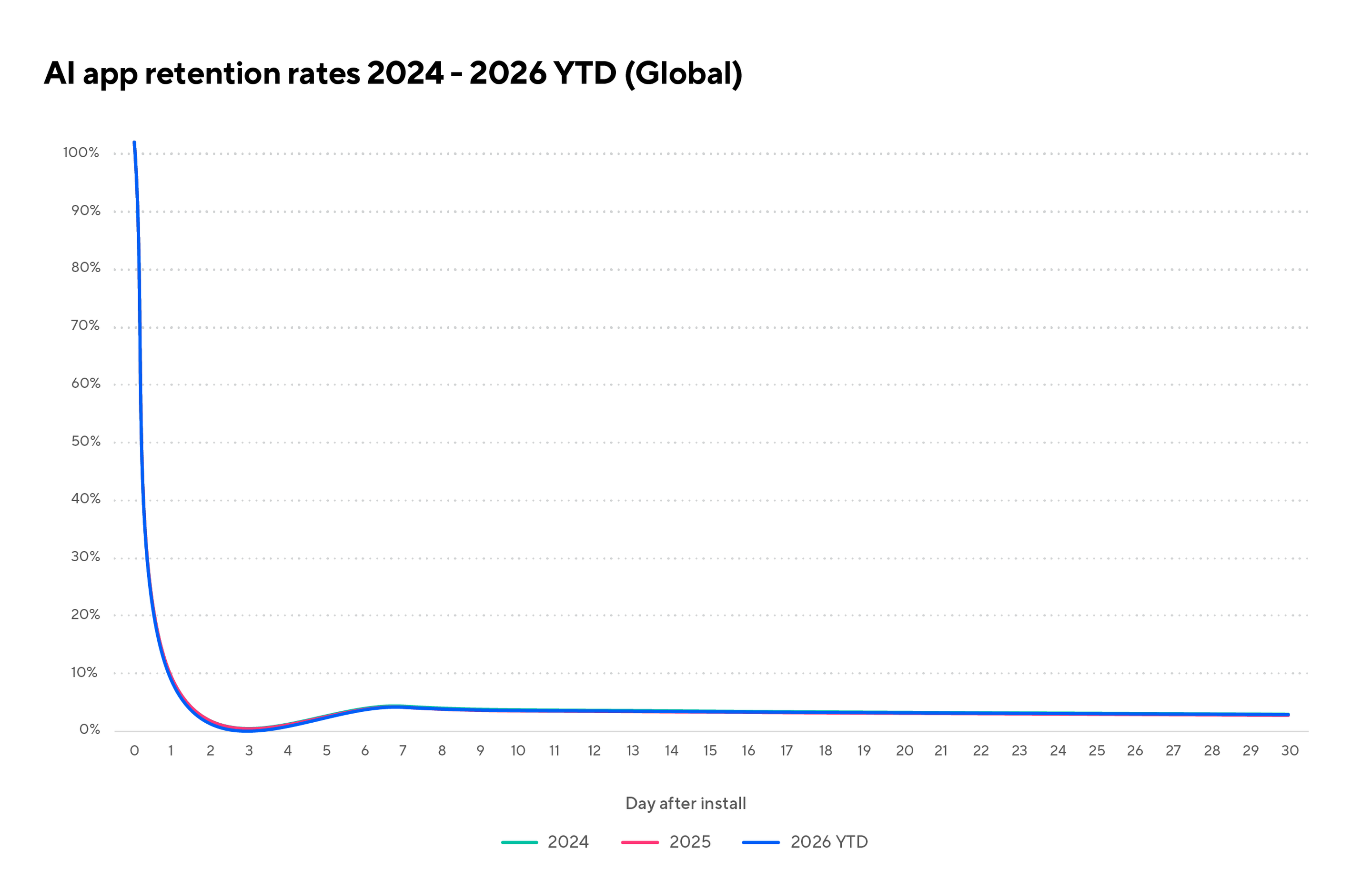
Day 1 retention rates for all of the subverticals, except for general AI apps, decreased in 2026. General AI apps retain 9.3% of users on day 1 in 2026, up from 8.3% in 2025 and 7.3% in 2024.
Regionally, North America retains best on day 1 at 7.1%, with Europe at 6.7%. APAC, LATAM, and MENA cluster between 5.5% and 6%.
Retention is the industry-wide weak spot. RevenueCat's 2026 State of Subscription Apps report, built on data from more than 115,000 apps, found that at the median, users cancel annual subscriptions to AI apps 30% faster than to non-AI apps. Twelve months in, AI apps keep 21.1% of annual subscribers against 30.7% for everyone else. That report measures paid subscriptions rather than active users, so the figures aren't directly comparable to the retention rates above, but both datasets point to the same issue.
Where AI app marketers should focus next
AI apps have acquisition figured out, so retention is the next opportunity. A channel delivering cheap installs that vanish by day 2 is more expensive than it looks. With Adjust Measure, marketers can follow users past the install and compare channels on day 1 and day 7 behavior instead of cost per install (CPI) alone, so the budget moves toward the sources that bring users who return.
The first week after a user downloads an AI app is where marketers can make the most difference. Pulse alerts can flag a dip in day 7 retention the moment it shows up in a cohort, while the window to act is still open. Then, Audiences can turn that cohort into a reachable segment of users who installed but went quiet.
Most AI apps monetize through subscriptions. Adjust's subscription measurement can connect each channel to trial starts, renewals, and lifetime value, so marketers can see which sources bring subscribers who renew rather than ones who cancel at the first billing date.
If you want to see how Adjust could work for your AI app, request a demo today.
Be the first to know. Subscribe for monthly app insights.
Keep reading
